Hardware · CAD · Additive Manufacturing
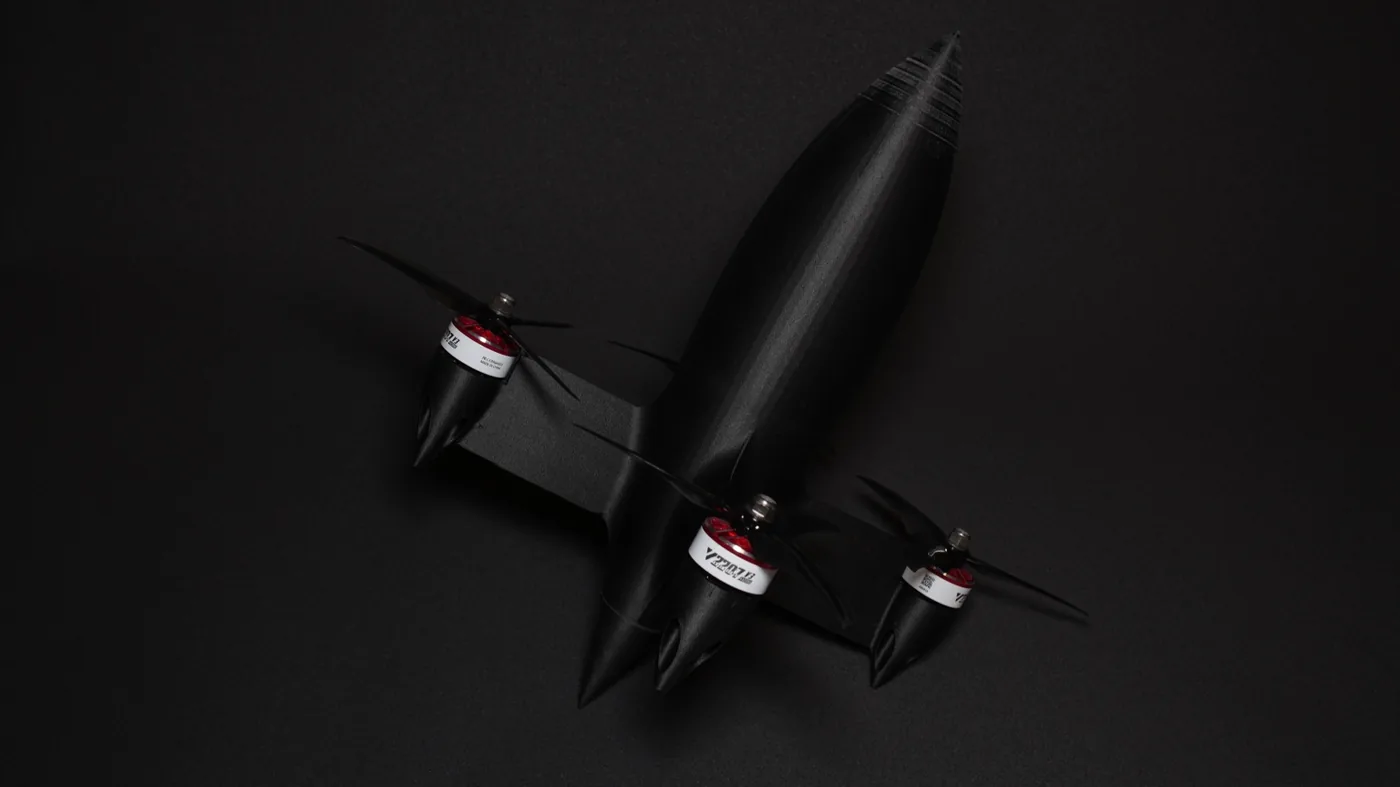
Iterative development of a performance-oriented drone prototype
A flight-capable first revision whose flight tests, material behaviour and thermal measurements define a new 7-inch revision with components rated up to 12S.
Revision 1 flight-capable · Revision 2: components ordered, CAD in development
- Timeframe
- 2026 · revision 1 flight-capable, revision 2 in development
- Design iterations
- 4–5 major Onshape revisions
- Revision 2
- 7-inch carbon frame · components rated up to 12S
- Documented spend
- ≈ €424 of a €700 budget
Objective and scope
The goal was a compact, performance-oriented drone built without an off-the-shelf frame. Revision 1 was designed around a 6S powertrain with a target speed of roughly 170 km/h — derived from the pitch speed of that motor and propeller combination and never presented as a measured result. With revision 2 redesigned from the ground up, the new development target is 400 km/h. That figure has likewise not been achieved or verified by measurement.
I completed the project independently over roughly 200 hours: component selection, mechanical design, additive manufacturing, soldering, assembly, Betaflight configuration, PID work and flight testing.
Mechanical and electrical design
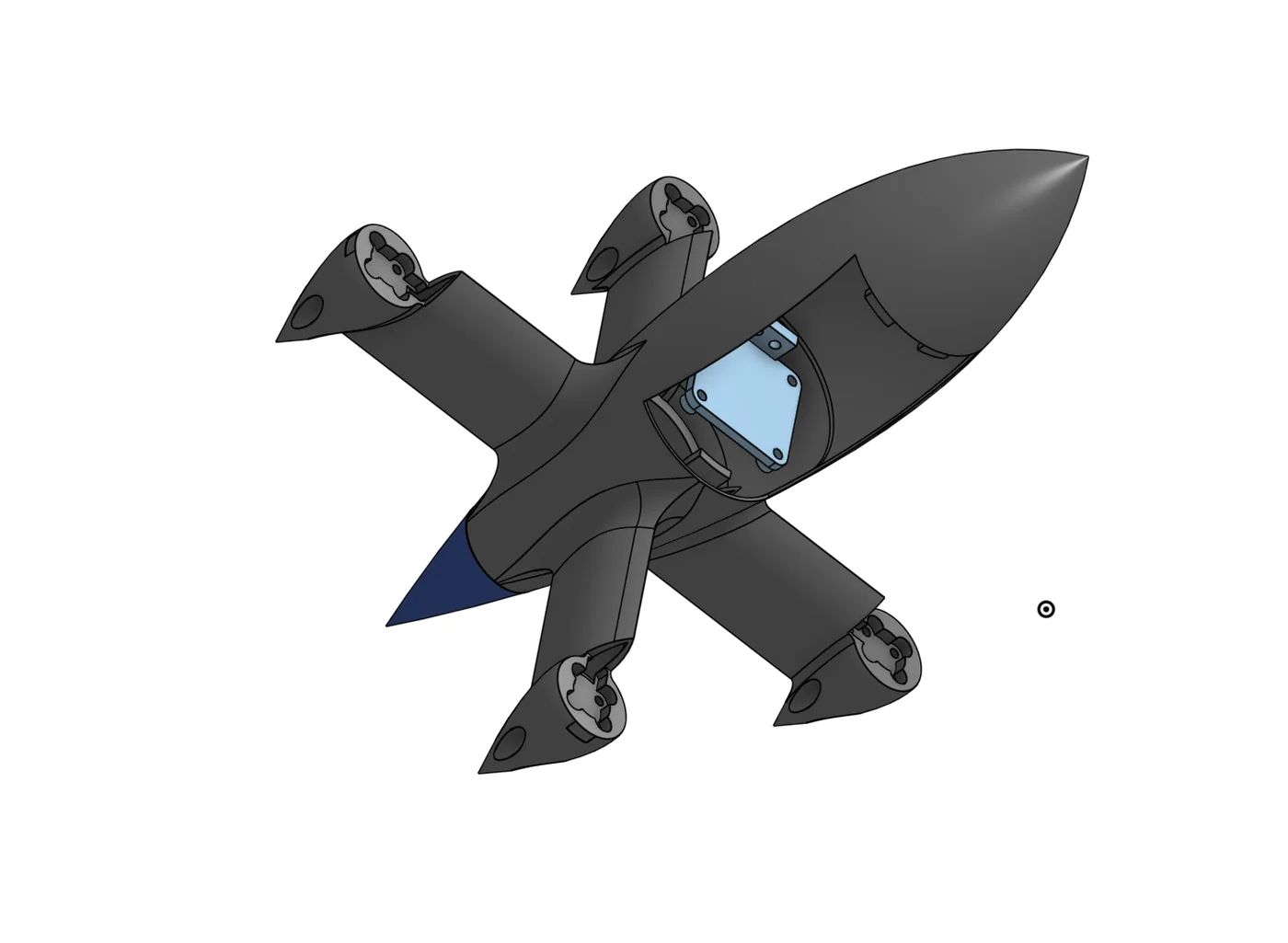
The load-bearing frame, body and component packaging were developed through four to five major Onshape iterations. The geometry had to balance stiffness, aerodynamics, cooling, available space, repairability, printability and cost.
| Subsystem | Revision 1 choice | Design rationale |
|---|---|---|
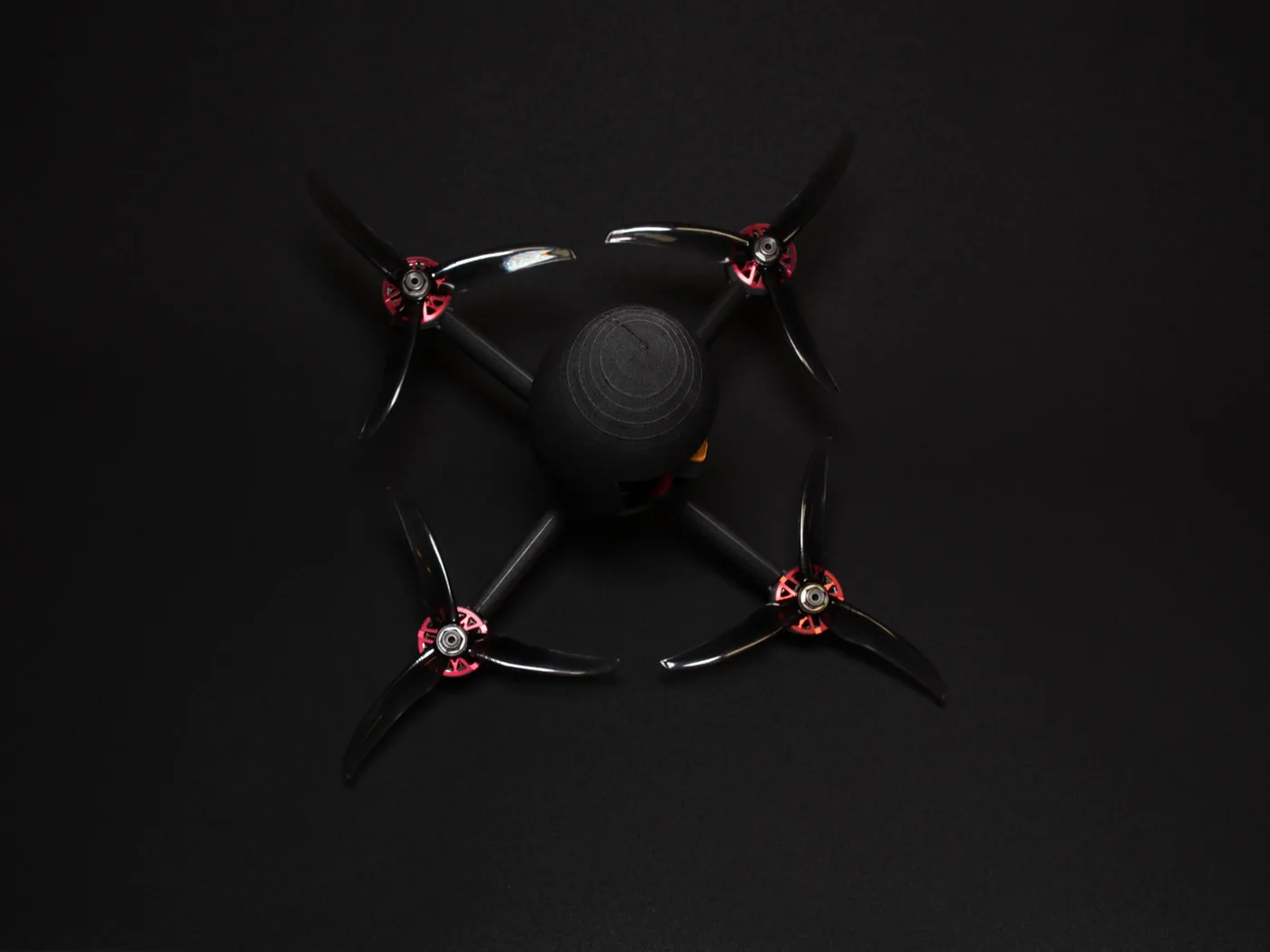
| Motors | T-Motor Velox V2207 V3 · 2050 KV · 6S | Performance at a controlled component cost |
| Flight control | SpeedyBee F405 V5 · 55 A stack | Reliability prioritized for a central system component |
| Control link | RadioMaster RP3 V2 · ELRS | Robust link with a compact receiver |
| Navigation | HGLRC M100 Pro GPS | Required positioning without paying for unused features |
| Propulsion | T-Motor T5143S · 5.1-inch · three-blade | Matched to the selected 6S powertrain |
Flight testing and learning
Revision 1 completed one hover test and two controlled flights. Early in testing the prototype crashed, while PID tuning and my own flight experience were still insufficient. I responded by practicing in a simulator and building a second, easier-to-fly training drone before continuing — cheaper than repeatedly repairing the prototype.
Evidence from revision 1
Practical tests revealed three linked weaknesses. Frame resonance complicated PID tuning, and the PA-CF structure became more flexible as it absorbed moisture over time. Infrared measurements showed heat build-up around the flight controller and the 4-in-1 ESC. Finally, the top-mounted battery placed too much mass high in the structure.
Each finding maps directly to a change in revision 2:
- Vibration: switch from the printed PA-CF load-bearing frame to a symmetrical 7-inch carbon frame
- Cooling: more deliberate airflow and a new layout for the flight controller and ESC
- Weight distribution: battery positioned lower, lighter components higher
- Control: DJI O4 FPV added before any performance testing
Revision 2 · redesigned from the ground up
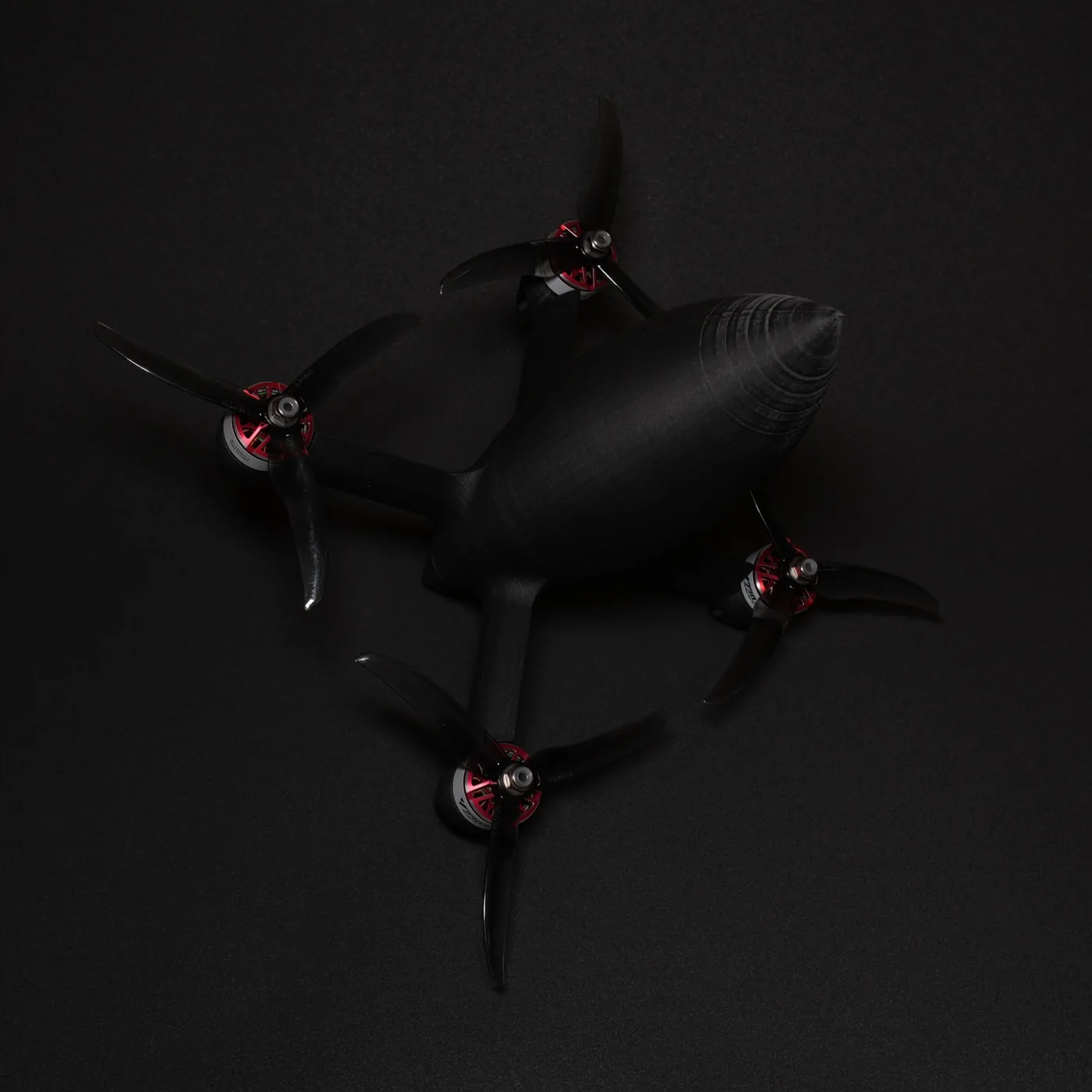
All components for revision 2 have been ordered, an initial CAD state exists and the design is being developed further. The new build replaces the frame, motors, ESC, flight controller and propellers. The GPS module and ELRS receiver carry over from revision 1, while the existing ELRS transmitter also remains in use.
A symmetrical 7-inch carbon frame forms the load-bearing structure. A custom CAD-designed, 3D-printed body is built around it to improve aerodynamics. This separates the functions clearly: the carbon frame provides stiffness, while the body defines shape, airflow and component packaging.
The new powertrain combines T-Hobby 2816SE motors rated at 800 KV with 7×13-inch two-blade propellers. The components are rated up to 12S, corresponding to 44.4 volts nominal and 50.4 volts fully charged. A JIJIEFPV F722 12S/120 A FC/ESC stack handles flight control and power regulation, while DJI O4 provides the FPV view.
The development target is 400 km/h. This figure describes the objective for the second revision only: an achieved top speed will be published only after the new build has passed controlled mechanical, thermal and flight testing and the result has been measured reliably.
- Load-bearing structure: symmetrical 7-inch carbon frame
- Aerodynamics: custom CAD-designed, 3D-printed body
- Powertrain: T-Hobby 2816SE · 800 KV · 7×13 inch · two-blade
- Electronics: JIJIEFPV F722 · up to 12S · 120 A · DJI O4 FPV
- Carried over: GPS module, ELRS receiver and ELRS transmitter
Commercial engineering
Revision 1 was planned against a €700 budget and came in at approximately €424 of documented direct expenditure, including the transmitter, around 1.4 kg of development material and €105 of DJI O4 FPV hardware. Excluding that FPV hardware, revision 1 cost approximately €319.
Replacing most components in revision 2 is a deliberate technical and commercial decision. Revision 1 served as a learning platform and showed how structure, cooling and mass distribution need to change. Reusing most of the 6S hardware would have reduced short-term cost, but it would also have constrained the new power class and the structural improvements.
| Decision | Economic reasoning | Technical consequence |
|---|---|---|
| Motors, GPS and material | Selected for sufficient performance without paying for unused capability | Meet current prototype requirements |
| Flight controller and ESC | Higher spend on the central, reliability-critical electronics | 55 A stack selected instead of an unbranded alternative |
| Custom printed frame | No available frame matched the intended geometry | Fast design changes and learning, at the cost of 10–15 development prints |
| Carbon frame plus custom body | Load-bearing stiffness and adaptable aerodynamics are solved separately | Proven structural format combined with a custom outer shape |
| New powertrain instead of reuse | Additional cost is accepted in favour of the new power class | System rated up to 12S; only GPS, ELRS receiver and transmitter carry over |
Result
Revision 1 is complete: it proved that the self-designed system flies, and it produced concrete, measured design evidence for the next build. The project’s value so far is that evidence chain — three flights turned into a specific, justified specification for revision 2 rather than a redesign by intuition, including the decision to change power class instead of patching.